



Table of Contents
ToggleLanded cost for importers used to be a number that finance teams worked out when a supplier changed its price and then trusted for months. In 2026 that habit has become expensive. A US distributor that cleared a container of kitchenware in January paid one set of tariffs. The container that cleared in March paid a different set, and the one that arrived in August paid a third. All three now sit on the same warehouse shelf under the same SKU, and the accounting system is expected to know which cost belongs to which unit.
Then there is the paperwork. The supplier invoice arrives with the goods, and the ocean freight bill turns up two weeks later. The customs broker’s statement, carrying duty and CBP fees, lands after that, sometimes when half the shipment has already been sold. If those bills are coded to a general freight or duty expense account, the gross margin report for that month looks healthier than it really is. The next month looks worse, and nobody can explain why.
This guide explains what landed cost for importers should include and how calculating landed cost for imported goods works in practice. It shows why the allocation method you choose quietly changes the margin on every product, how Cin7 and Microsoft Business Central deal with late invoices, and what US tax and accounting rules expect to see. The goal is simple: a landed cost for importers that you can defend to your auditor, your bank and your own pricing team.
What Landed Cost for Importers Actually Covers
Before any system can calculate landed cost for importers, everyone involved needs to agree on what goes into it. In plain terms, it is every cost you pay to move a product from the supplier’s door to a sellable position in your own warehouse.
Supplier price → Freight → Insurance → Duty and tariffs → CBP fees → Brokerage → Inland delivery → Landed cost per unit
Microsoft describes it the same way in its Business Central documentation on item charges, where the landed cost of a purchased item is the vendor’s price plus the direct charges that can be tied to individual receipts. The table below shows where each piece of landed cost for importers usually comes from and why the timing matters.
| Cost Element | Who Usually Bills It | When the Bill Tends to Arrive |
|---|---|---|
| Product price, net of trade discounts | Supplier | With or before the goods |
| Ocean or air freight | Freight forwarder or carrier | Days or weeks after departure |
| Cargo insurance | Forwarder or insurer | With the freight bill, or monthly |
| Customs duty and tariffs | CBP, collected through your broker | On the entry summary |
| Merchandise Processing Fee and Harbor Maintenance Fee | CBP, collected through your broker | On the entry summary |
| Brokerage and port charges | Customs broker | After clearance |
| Drayage and inland freight | Trucking provider | After delivery |
What Usually Stays Out
Some costs feel like part of importing but belong somewhere else. Outbound shipping to customers, marketplace fees and interest on trade finance are selling or financing costs, so they sit outside landed cost for importers. Storage and handling after receipt is a grey area. Smaller resellers usually expense it, while larger businesses under the uniform capitalisation rules may need to capitalise a share. The tax section below explains where that line falls.
Why the Duty Line Moved Three Times in 2026
For most of the past decade, duty was the most predictable part of landed cost for importers. That changed for anyone shipping into the United States this year. The sequence is worth laying out plainly because each change reset landed cost for importers on every new shipment.
| Period | Tariff Authority | What It Meant for Importers |
|---|---|---|
| February 2025 to February 2026 | IEEPA | Country-specific tariffs, later ruled unlawful by the Supreme Court |
| 24 February to 24 July 2026 | Section 122 | A temporary 10% global surcharge |
| From 24 July 2026 | Section 301 | 10% or 12.5% on imports from 60 economies |
On 20 February 2026, the Supreme Court held 6 to 3 that IEEPA does not allow the President to impose tariffs. A temporary 10% surcharge under Section 122 replaced those duties until it expired on 24 July. The Office of the US Trade Representative then imposed Section 301 tariffs on 60 economies, and PwC notes those partners account for roughly 99% of US imports. The rate depends on the country of origin. The UK, Canada, Mexico and India sit in the 10% group, while most other investigated economies face 12.5%.
Money may also flow the other way. CBP has been building a refund process called CAPE for IEEPA duties. Court filings cited by Skadden put the number of importers who paid those duties at about 330,000. Any refund has to be traced back to the entries it relates to, and units still in stock are treated differently from units already sold. A clean link between each customs entry and each SKU matters more for landed cost for importers this year than ever.
Three Tariff Regimes in One Bin
Stock received under different tariff regimes often shares a location. How that cost reaches your income statement depends on your valuation method:
- FIFO (first in, first out): the oldest landed cost leaves inventory first, so older tariff rates hit COGS before newer ones.
- LIFO (last in, first out): the newest landed cost hits COGS first. LIFO is permitted under US GAAP and for US tax purposes.
- Weighted average cost: each receipt blends into a running average, smoothing jumps but hiding which shipment caused them.
Each method gives a different margin for the same sale, so settle and document your method before tariffs move again.
Calculating Landed Costs for Imported Goods, Step by Step
The mechanics of landed cost for importers are simple once the inputs are clean. The process below is the one we use when calculating landed costs for imported goods for distributors. The example uses illustrative numbers, so use it to follow the logic and apply your own rates.
- Start with the entered value. This is the value declared to CBP, usually the invoice price of the goods.
- Add duty and tariffs. Apply the rate for each product’s HTS code and country of origin, including Section 301 or 232 duties.
- Add CBP fees. For fiscal year 2026, the Merchandise Processing Fee is 0.3464% of entered value, with a minimum of $33.58 and a maximum of $651.50 per formal entry. Ocean shipments also carry the Harbor Maintenance Fee, generally 0.125% of cargo value.
- Add freight, insurance, brokerage and inland delivery. Use actual invoices or documented estimates.
- Allocate each cost to SKUs. Use a basis that reflects what drives each cost.
- Divide by units received. This gives landed cost for importers at unit level, which becomes the inventory value in your system.
The formulas look like this:
Total landed cost = Product value + Duty + CBP fees + Freight + Insurance + Brokerage + Inland delivery
Landed cost per unit = Landed cost allocated to the SKU ÷ Units received
Landed cost uplift % = (Landed cost per unit − Supplier unit price) ÷ Supplier unit price × 100
A Worked Example With Two Products
Picture one container holding a compact product and a bulky one, a common mix when working out landed cost for importers. SKU A is 2,000 units at $12.00, each taking 0.01 cubic metres. SKU B is 1,500 units at $24.00, each taking 0.03 cubic metres. Total product value is $60,000.
For this example, assume a combined duty rate of 15% ($9,000), MPF of $207.84, HMF of $75.00, insurance of $300, brokerage of $450, ocean freight of $4,200 and drayage of $1,050. The extra costs add up to $15,282.84, which lifts the shipment’s total cost by about 25%.
| Allocation Approach | SKU A Landed Cost per Unit | SKU B Landed Cost per Unit |
|---|---|---|
| Everything allocated by value | $15.06 | $30.11 |
| Duty, fees, insurance and brokerage by value; freight and drayage by volume | $14.81 | $30.44 |
SKU B fills more than two thirds of the container but carries only 60% of the value. Allocating everything by value makes the bulky product look about 32 cents a unit cheaper than it really is. That puts close to $485 of margin on the wrong product in a single container. Over a year of shipments, the gap can make a product look like a winner while the rest of the range quietly subsidises it. When getting landed cost for importers right, where each dollar is allocated matters as much as the total.
Landing Cost Calculation for Imports When the Bills Arrive Late
Most errors in landed cost for importers come from timing. A dependable landing cost calculation for imports has to cope with invoices that turn up after the stock has been received, and sometimes after it has been sold.
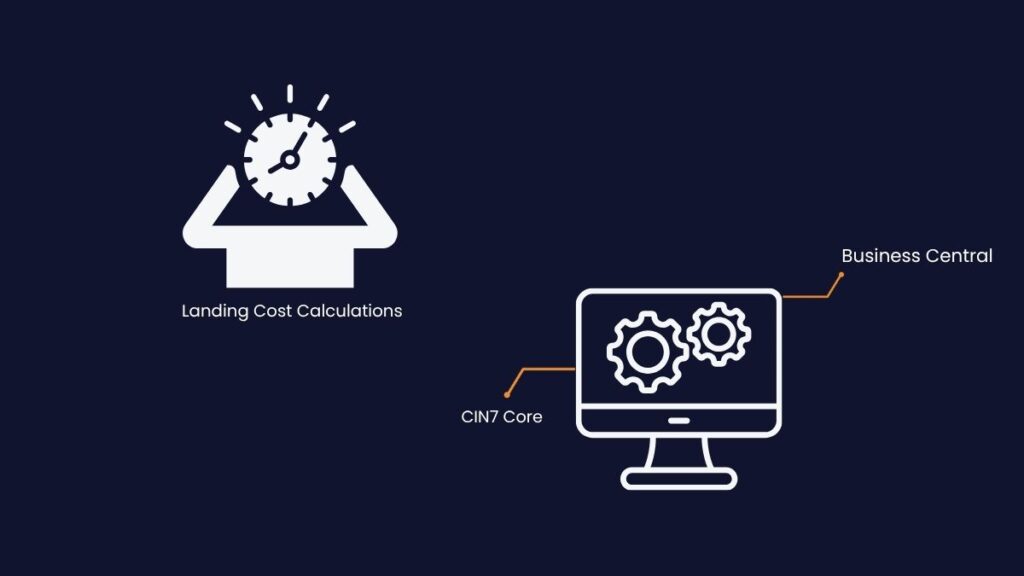
The most reliable approach is to post estimated freight and duty to inventory at the point of receipt, with the other side of the entry sitting in an accrued landed cost account. When the real invoices arrive, you clear the accrual. Any difference goes to inventory for units still on hand and to COGS for units already sold. A monthly cut-off stops the variance from drifting. At that cut-off, every open shipment is either trued up or carried forward with a documented estimate.
How Cin7 Core Handles It
Cin7 Core lets you add landed costs through a purchase’s additional costs, a manual journal or a separate invoice, and it can distribute them by cost, quantity, weight or volume. Its landed cost documentation also covers late costs. If landed costs are added after an item has shipped, Cin7 Core posts a second COGS journal dated when the landed cost is authorised. That keeps the numbers complete, but it also means a month you have already reported can shift later.
For landed cost for importers using Cin7 with QuickBooks or Xero, the cut-off discipline above keeps those late journals under control.
How Business Central Handles It
Business Central uses item charges. You can assign a charge on the same purchase invoice or link it later to a posted receipt. The standard distribution options are Equally, By Amount, By Weight and By Volume. For importers with many containers a month, that structure makes a consistent landing cost calculation for imports much easier to audit. Our guide on how to automate COGS tracking shows how these entries flow through to margin reporting.
Where Landed Cost Leaks Between Systems
In most businesses we review, the formula for landed cost for importers is fine. The leak happens at the handover between the inventory system, the accounting system and whoever processes supplier bills. These questions tend to find it quickly:

- Is the forwarder’s freight bill coded to inventory, or to a general freight expense account in QuickBooks or Xero?
- Does the broker’s statement get split into duty, fees and brokerage, or posted as one lump sum?
- Are foreign currency supplier invoices converted at the receipt date or the payment date, and does everyone know which?
- When a container is split across two warehouses, does the landed cost follow the units?
- Who owns the monthly reconciliation between the inventory sub-ledger and the general ledger?
If two or more of those answers are unclear, landed cost for importers in your business is probably understated somewhere. We cover the knock-on effects in our article on wholesale accounting mistakes that distort inventory. The month-end routine that prevents them is in our inventory accounting checklist for wholesalers.
What US Tax and Accounting Rules Expect
Landed cost for importers also shapes your statutory numbers. It drives inventory value on the balance sheet and COGS on the tax return, so your system has to follow the rules.

For tax, Treasury Regulation §1.471-3(b) defines the cost of purchased merchandise as the invoice price less trade discounts, plus transportation and other charges needed to take possession. An IRS Chief Counsel memorandum confirms that a reseller not applying Section 263A may capitalise only the net invoice price and those acquisition charges. Some businesses sit above the Section 448(c) gross receipts threshold, which starts at $25 million and is adjusted for inflation each year. Those businesses fall under the uniform capitalisation rules and may need to capitalise extra purchasing, storage and handling costs as well.
For financial reporting, KPMG’s 2026 comparison of US GAAP and IFRS summarises the principle under ASC 330: inventory cost includes purchase costs and other costs incurred to bring stock to its present location and condition. If you also report in the UK under FRS 102 or under IFRS, LIFO is not permitted there. Groups with US and UK entities may therefore need two views of landed cost for importers.
Using Landed Cost to Make Better Buying Decisions
Once the numbers are reliable, landed cost for importers stops being a compliance exercise and starts shaping commercial decisions.

A supplier quoting $11.50 ex-works can produce a higher landed cost for importers than one quoting $12.20 FOB. That happens once inland freight in the origin country, export handling and a higher duty tier are added. The Incoterms on each quote decide who pays for each leg, so compare quotes only after calculating landed cost for imported goods on a like-for-like basis.
The 2026 Section 301 structure means two factories making the same product can carry different duty rates. Moving production from a 12.5% economy to a 10% economy may lower landed cost for importers. Longer transit times, higher freight or minimum order changes can still cancel out the saving, so run the full calculation before moving a purchase order.
Price lists built on supplier cost plus a fixed mark-up break down when duty changes three times in a year. Pricing from landed cost for importers at unit level keeps channel and customer margins honest, as long as you review it whenever a new receipt changes the average.
Final Thoughts
The pressures covered in this article tend to arrive together. Tariffs changed three times in 2026, freight and broker invoices still arrive after the goods, and inventory and accounting systems often disagree about where those costs belong. Together, they produce margins that look fine in one report and fall apart in the next.
A reliable landed cost for importers fixes that at the source. That means calculating landed costs for imported goods with a consistent method, clear allocation rules, accruals for late invoices, and a monthly reconciliation. Once those are in place, the number on each SKU becomes something you can price from, buy from and report on with confidence. It also makes tariff refunds, audits, and lender conversations easier, because every dollar of duty traces back to its entry and product.
At VNC Global, we help product-based businesses get landed cost for importers right. We connect finance, inventory, operations, reporting, and automation so the numbers match across Cin7, Business Central, QuickBooks and Xero. That can mean configuring landed cost templates and item charges, setting up accruals and cut-offs, cleaning up historical costing, or building SKU-level margin reporting leadership can trust. You can see how we approach system setup on our Cin7 Core experts page.
If your landed cost for importers still lives in a spreadsheet, or margins shift every time a freight invoice lands, a short conversation is a sensible first step. We will review how your costs flow today and show you where the gaps are.
Frequently Asked Questions
Landed cost for importers is the total cost of getting a product into your warehouse ready to sell. It includes the supplier price plus freight, insurance, duties, CBP fees, brokerage and inland delivery, allocated to each unit received.
Start with the entered value and add duty and CBP fees. Then add freight, insurance, brokerage and inland delivery. Allocate each cost to SKUs by value, weight or volume, and divide by units received.
For landed cost for importers in the US, freight-in and duty on purchased stock should generally be added to inventory under tax rules and GAAP. They then flow into COGS when sold. Outbound shipping to customers is usually a selling expense.
A temporary 10% Section 122 surcharge replaced IEEPA tariffs in February 2026. Section 301 tariffs of 10% or 12.5% then replaced that surcharge from 24 July. Each change altered duty on new shipments, so stock bought at different times now carries different costs.
Cin7 Core posts a second COGS journal dated when the late landed cost is authorised. This keeps total COGS complete but can move results in a period you have already closed, so a monthly cut-off routine is important.
Spreadsheets become hard to reconcile once you receive several containers a month, sell across more than one channel, or face frequent tariff changes. At that point landed cost for importers starts to drift. Moving the calculation into Cin7 or Business Central with documented rules gives cleaner margins and a faster month-end close.