


Table of Contents
ToggleKnowing how to prepare inventory levels for Cyber Monday demand comes down to three numbers you can work out this week. The first is how much each product is likely to sell. The second is how long your suppliers take to deliver. The third is how much extra stock you can afford to hold as a buffer. Cyber Monday is on 30 November 2026, which gives you about six weeks to get them right.
Those numbers matter more this year. Adobe expects Cyber Monday to bring in $15.1 billion of US online sales, up from $14.25 billion in 2025. For a business selling through Shopify, Amazon, and wholesale accounts at once, demand in late November can move far faster than your usual reorder settings expect.
Most reorder settings in Cin7 Core, Xero, or QuickBooks were set up with an ordinary month in mind. Below is how to prepare inventory levels for Cyber Monday demand in five steps, the same ones we use with wholesalers, distributors, and multichannel retailers. Each step includes the formula and a worked example you can copy into a spreadsheet.
Why Cyber Monday 2026 Will Stretch Your Stock Further Than Last Year
This year’s forecasts show more online spending than 2025, with more of it happening before Cyber Monday. That affects how to prepare inventory levels for Cyber Monday demand this year.

- Five Busy Days: Adobe expects Cyber Week, from Thanksgiving to Cyber Monday, to bring in $47.5 billion. That is 17.3% of all holiday online spending.
- Earlier Demand: Black Friday is growing faster than Cyber Monday, up 9.2% to $12.9 billion, so stock must be ready before Thanksgiving week.
- Online Outgrowing Retail: Deloitte expects holiday ecommerce to grow 7.5% to 8.4% from November to January, against 4.0% to 4.8% for total retail.
- Everyday Lines Spike Too: Adobe expects Cyber Week online sales of personal hygiene products to run 150% above September’s average. Baby products are expected to run 113% above and pet products 93% above.
Stock problems also cost retailers a lot of money. IHL Group’s 2026 Inventory Distortion Study puts the global cost of out-of-stocks and overstocks at $1.7 trillion, about 6.2% of retail sales. So it makes sense to decide how to prepare inventory levels for Cyber Monday demand in October, while you still have time to order.
How to Prepare Inventory Levels for Cyber Monday Demand in 5 Steps
Each step uses the numbers from the one before it, so work through them in order. If you are short on time while deciding how to prepare inventory levels for Cyber Monday demand, do a lighter version of each step.

1. Reconcile Your Stock Before You Forecast It
If your stock figures are wrong, your forecast will be wrong too. That is why the first part of how to prepare inventory levels for Cyber Monday demand is an accurate count. Before you start demand forecasting, confirm two things. System quantities should match the warehouse, and stock value should match the general ledger.
- Count What Matters Most: Cycle count the top 20% of SKUs by revenue and post the variances.
- Reconcile the Ledger: Match the inventory account in Xero or QuickBooks Online to the Cin7 Core stock valuation, and chase any COGS journals that failed to post.
- Clear Stuck Transactions: Close part-received purchase orders, unallocated sales orders, and incomplete transfers.
- Update Landed Costs: Freight, duty, and tariff changes must be in product costs before you set holiday discounts.
Most peak-season problems we see start here. It is also the monthly work our inventory and finance reconciliation team does for product businesses.
2. Build an SKU-Level Holiday Demand Forecast
Holiday demand forecasting is the part of preparing inventory levels for Cyber Monday demand where SKU-level detail matters most. Cyber Monday can triple sales of one product and barely change another.
- Pull the Right History: Export last year’s daily sales by SKU and channel for the peak weeks and a baseline month such as September.
- Calculate a Lift Factor: Divide each SKU’s peak daily average by its baseline average.
- Correct for Stockouts: If an SKU sold out on the Saturday, its recorded Cyber Monday sales understate real demand.
- Adjust for This Year: Include new products, promotions, and channels.
- Sense-Check Against the Market: Adobe expects Cyber Week online sales of clothing basics to run 210% above September’s average, which is roughly 3.1 times normal. If your forecast for similar lines is much lower, check why before you order.
Good ecommerce inventory forecasting is done channel by channel. Shopify, Amazon FBA, and wholesale customers all sell from the same stock, but they order at different times. If you are working out how to prepare inventory levels for Cyber Monday demand across three or more channels, forecasting each channel separately will usually change your purchase quantities the most.
Cin7 Core’s reorder suggestions forecast sales from your history, and ForesightAI adds AI-based predictions. Both depend on clean history. We covered the cost of weak forecasts in the real cost of poor inventory forecasting.
3. Set Reorder Points Using Real Lead Times
Reorder points tell you when to buy, which is a big part of how to prepare inventory levels for Cyber Monday demand. A reorder point is the stock level that triggers a replenishment order so new stock arrives before you run out. Microsoft’s Business Central documentation describes it as demand during lead time.
The reorder point formula is:
Reorder Point = (average daily demand × lead time in days) + safety stock
Here is an illustration. A SKU forecast to sell 60 units a day with a 14-day lead time has lead time demand of 840 units. Add 435 units of safety stock from Step 4 and the reorder point is 1,275 units.
Three adjustments make the reorder point formula work at peak:
- Use peak demand for peak weeks. Annual averages trigger orders too late.
- Use real lead times. Count from the purchase order date to the day stock can be sold.
- Check the calendar. If lead time exceeds the time left before 30 November, focus on allocating the stock you hold.
In Cin7 Core, the Minimum Before Reorder field acts as your reorder point and can be set per location. That helps when you are deciding how to prepare inventory levels for Cyber Monday demand across warehouses.
4. Size Safety Stock by How Much Each SKU Matters
Safety stock absorbs forecast errors and late deliveries. The same buffer on every SKU ties up cash in lines that do not need it.
The simplest safety stock formula uses your worst recent case:
Safety Stock = (maximum daily sales × maximum lead time) − (average daily sales × average lead time)
Take the same SKU. If peak sales could reach 75 units a day and lead time could stretch to 17 days, the result is (75 × 17) − (60 × 14) = 435 units.
With enough clean history, the statistical version is more precise:
Safety Stock = Z × standard deviation of daily demand × √lead time in days
A Z of about 1.65 targets roughly a 95% service level.
Business Central’s reordering best practice guide uses ABC classification. In it, A items are typically 10% to 20% of stock volume but 50% to 70% of value. A sensible rule for how to prepare inventory levels for Cyber Monday demand is to give A items the highest service level and accept leaner buffers on C items. Review whichever safety stock formula you use weekly through November.
5. Protect Cash Flow and Plan for the January Slowdown
You pay for Cyber Monday stock before you sell it, so check that the cash works too.
- Map Cash In Against Cash Out: Line up supplier payment dates against when Shopify, Amazon, and wholesale customers pay you.
- Track Inventory Turnover by SKU: Inventory turnover is cost of goods sold divided by average inventory. $6 million of COGS on $1.5 million of average inventory is four turns a year.
- Agree the Exit Plan Now: For each large Cyber Monday inventory buy, decide what happens to leftover units in mid-December.
- Protect Discounted Margins: Adobe expects Cyber Week discounts of up to 30%, so an outdated landed cost can turn a promoted line into a loss.
Bring your finance team into decisions about how to prepare inventory levels for Cyber Monday demand, because large October orders affect your cash position in January. Regular payout reconciliation through proper ecommerce accounting shows you where that cash stands each week.
Where Cyber Monday Inventory Plans Usually Break
Peak-season problems in the businesses we support come from a short list of causes, each avoidable with a few weeks’ notice.

- Forecasting from capped sales, so last year’s stockout repeats.
- Treating every channel as one pool until FBA deadlines and wholesale allocations collide.
- Setting reorder points once in September and never revisiting them.
- Forgetting bundles and kits, which use up component stock.
- Counting stock after the peak, when variances are hardest to trace.
- Discounting on stale landed costs that leave out this year’s freight or tariff changes.
Most of these come down to process. A good plan for how to prepare inventory levels for Cyber Monday demand therefore includes a weekly review of your Cyber Monday inventory.
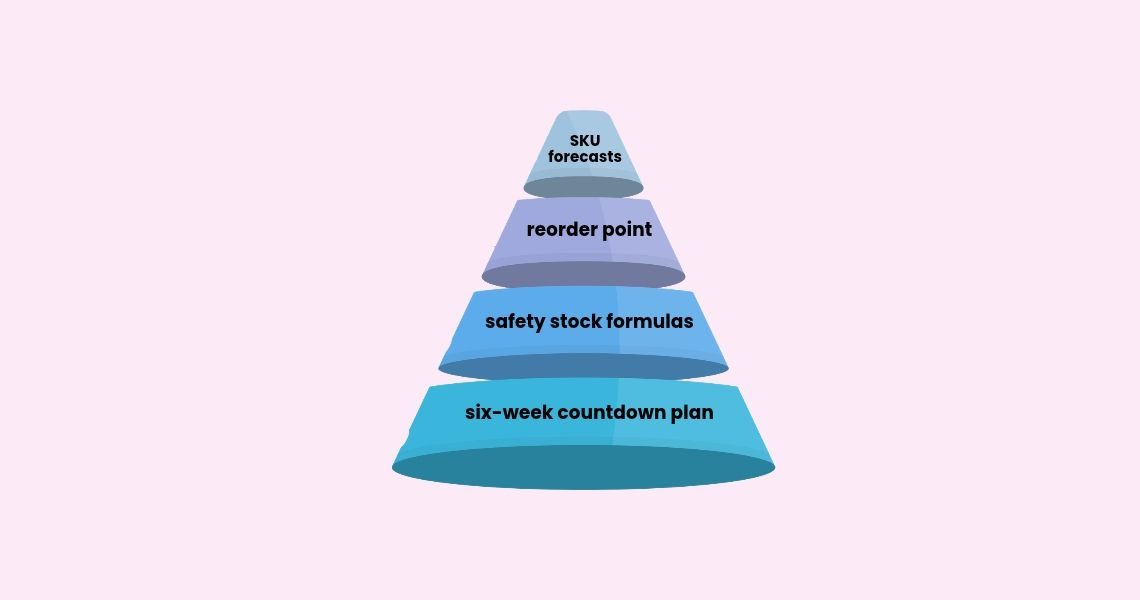
A Six-Week Countdown for How to Prepare Inventory Levels for Cyber Monday Demand
Here is how to prepare inventory levels for Cyber Monday demand week by week, starting from 19 October. Move dates earlier if your 3PL, Amazon FBA or carrier cut-offs fall sooner.
| Week Starting | Focus |
|---|---|
| 19 October | Count A items, reconcile stock, update landed costs |
| 26 October | Build the SKU and channel forecast, agree promotions |
| 2 November | Set reorder points and safety stock, place final domestic orders |
| 9 November | Allocate stock by channel, agree exit rules |
| 16 November | Receive final stock, re-count top SKUs |
| 23 November | Thanksgiving and Black Friday: daily stock and sell-through reviews |
| 30 November | Cyber Monday: watch A items, pause ads on SKUs near zero |
| 7 December | Reconcile sales, payouts and COGS, start exit plans |
A timeline like this spreads the work for how to prepare inventory levels for Cyber Monday demand across six weeks, so less is left for the final days.
Final Thoughts
Most of the work in how to prepare inventory levels for Cyber Monday demand is fixing a few common issues. Stock records may not match the ledger, and forecasts may be based on sales that were limited by stockouts. Lead times may be too optimistic, and safety stock may be spread evenly across every SKU. The five steps above help you fix each of these and use your holiday demand forecasting to plan purchase orders, channel allocations and cash.
This work involves purchasing, operations, marketing, and finance, and their numbers often sit in different systems. VNC helps bring them together. For more than 16 years, our bookkeeping and inventory experts have connected inventory, accounting, reporting, automation, and advisory on Cin7 Core, Xero, QuickBooks Online, and Business Central. Our aim is to be the most trusted accounting, inventory, analysis, automation, advisory and AI finance partner for mid-market product businesses. We work with businesses earning USD 5 million to USD 100 million across Australia, New Zealand, the USA, the UK and Switzerland.
Before your final purchase orders go out, take our free Holiday Readiness Scorecard. It is a 15-minute self-assessment for product businesses, with tips from the Best Cin7 Core Experts. It gives you a readiness score, a breakdown by area, and your top priorities. If the results raise questions, book a free 30-minute advisory session. We can talk through how to prepare inventory levels for Cyber Monday demand in your business before Thanksgiving.
Frequently Asked Questions
Work back from your longest supplier lead time. Sea freight imports need ordering months ahead, and domestic orders should go out by early November. When planning how to prepare inventory levels for Cyber Monday demand, start reconciling stock at least six weeks before the day.
The reorder point formula is average daily demand multiplied by lead time in days, plus safety stock. Many teams use it when working out how to prepare inventory levels for Cyber Monday demand. At peak, use forecast peak demand and measure lead time from purchase order to stock available to sell.
The simplest safety stock formula is (maximum daily sales × maximum lead time) minus (average daily sales × average lead time). With clean history, use Z × standard deviation of daily demand × the square root of lead time.
Holiday demand forecasting applies a lift factor to each SKU’s normal baseline and corrects for last year’s stockouts. That makes it central to preparing inventory levels for Cyber Monday demand. Regular demand forecasting assumes steady sales and underestimates the Cyber Week spike.
Yes. Cin7 Core generates reorder suggestions from sales history, supports Minimum Before Reorder levels by product or location, and offers ForesightAI. It works best once stock and sales records are reconciled with your accounting system. That reconciliation is the foundation of reliable ecommerce inventory forecasting and the first step in how to prepare inventory levels for Cyber Monday demand.
Focus on allocation. Decide which channels get the units you hold and limit promotions on that SKU. For long lead time lines, part of how to prepare inventory levels for Cyber Monday demand is noting the shortfall now, so next year’s orders go out earlier.