

Know What to Buy and when to Order With Free SKU Planning Tool
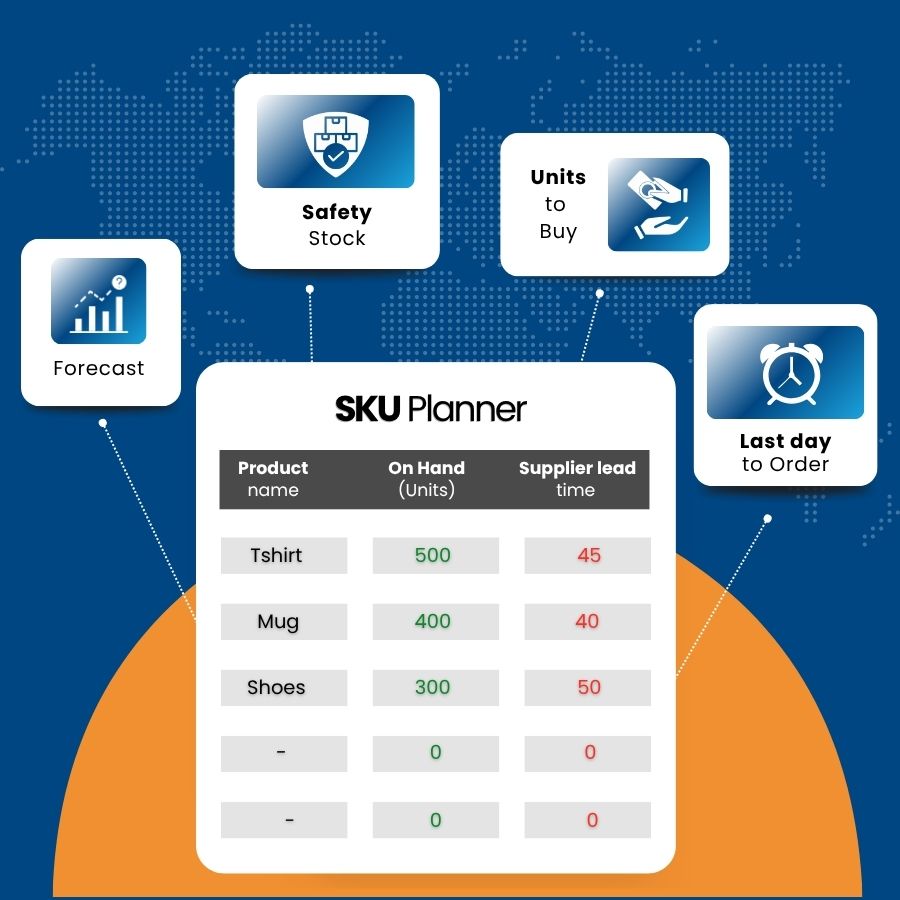
Add your top products, what you sold last season and how long your suppliers take to deliver. Our free SKU planning tool shows how many units to buy and the last day to place each order, so your bestsellers stay in stock through Black Friday and the holidays.
Why SKU Planning Breaks Down Before Peak Season
Peak season multiplies whatever is already slightly off. These are the 6 holiday readiness gaps product business owners raise most often during our conversations with them, and the scorecard checks every one.
Find out how many units each product needs and when to order.
It’s free, and you can start your SKU planning right now.
Find out how many units each product needs and when to order.
It’s free, and you can start your SKU planning right now.
What This Stock Planning Tool Calculates
SKU planning means working out how many units of each product to buy and when to order them. It uses your expected sales, the stock you already have and your supplier lead times. It starts with SKU-level forecasting, which means predicting sales for each product separately, since products in the same range rarely sell at the same pace. This stock planning tool gives you 6 results for every SKU you enter.
SKU Forecast
Units to Buy
Order-By Date
Safety Stock
Weeks of Cover
Purchase Value
How a SKU Planner Protects Your Holiday Season
Most business owners want the same 3 things from holiday buying. They want their bestsellers in stock, cash left in the bank and orders placed on time. An inventory planner built around SKU planning helps with all three.
Bestsellers Stay in Stock
Units to buy are set per SKU, so your top lines get the depth they need for the busiest weeks.
Less Cash Tied Up
Buying stops at what each SKU needs, which keeps cash free for payroll, marketing and the new year.
Orders Go in on Time
Order-by dates turn supplier lead times into a clear purchasing calendar your whole team can follow.
You Walk Away With: A SKU forecast, units to buy and an order-by date for every product you enter, plus a PDF plan to share with your team, suppliers or accountant.
This Scorecard is for You If:
16+ Years
Expertise With Product Businesses
Our bookkeeping and inventory experts work with product businesses across the US, UK, Australia and beyond, with one aim: to be the most trusted finance partner for these businesses across accounting, inventory, analysis, automation, advisory and AI.
What our Clients Say:
RATED 5 STARS
ON CLUTCH
How Much Should You Buy and By When?
Enter last year’s Oct to Dec sales for your top products. The planner works out your forecast, safety stock, units to buy and the last day to place each order. Light blue fields are yours to edit.
| SKU | Product name | Units sold Oct–Dec last year | Growth % (blank uses setting) | Forecast units | Safety stock units | On hand now | On order (open POs) | Units to buy | Supplier lead time (days) | Order by date | Status | Remove |
|---|
How it works: Units to buy = Forecast units + Safety stock − On hand − On order. Order by date = Stock needed by date − Supplier lead time. Treat results as a planning guide and sense-check them against your own knowledge of demand.
Want your buy plan built from live Cin7 data?
Book a CallVNC's inventory and accounting experts help product businesses set up reorder points, lead times and stock forecasting in Cin7, so peak season buying runs on numbers you trust.
More on SKU Planning for the Holidays
Helpful guides on SKU planning, protecting your margins and getting ready for the holiday rush.
Frequently Asked Questions
What is SKU planning?
How do I do SKU planning, step by step?
What is a SKU forecast?
How is my score calculated?
How is SKU-level forecasting different from category forecasting?
How do I calculate how much stock to buy?
How is the order-by date calculated?
How much safety stock should I hold?
What’s the difference between a reorder point and an order-by date?
A reorder point is a stock level that tells you to reorder during normal trading. An order-by date is a deadline for a one-off seasonal order. Most SKU planning uses both, with reorder points for everyday stock and order-by dates for peak season.